01
TBM and excavation friendly
GFRP is suitable where future mechanical excavation may intersect temporary reinforcement. This helps avoid steel obstruction at diaphragm walls, tunnel eyes, cross passages, shafts and break-through zones.

Cuttable composite ground support
A technical sales solution for main contractors who need a cuttable, corrosion-resistant and lighter ground-support system for excavation, ELS and tunneling works.
Product overview
DIVIDAC GFRP soil nails and rock bolts are offered for projects where steel support may create problems at a future excavation interface. The composite bar can be specified as a temporary or project-specific ground-support element for tunnel faces, TBM break-through zones, ELS works, soil nails and rock bolts.
The product pitch for main contractors is simple: reduce excavation risk, support faster sequencing and simplify interfaces where future cutting or mechanical excavation is expected.
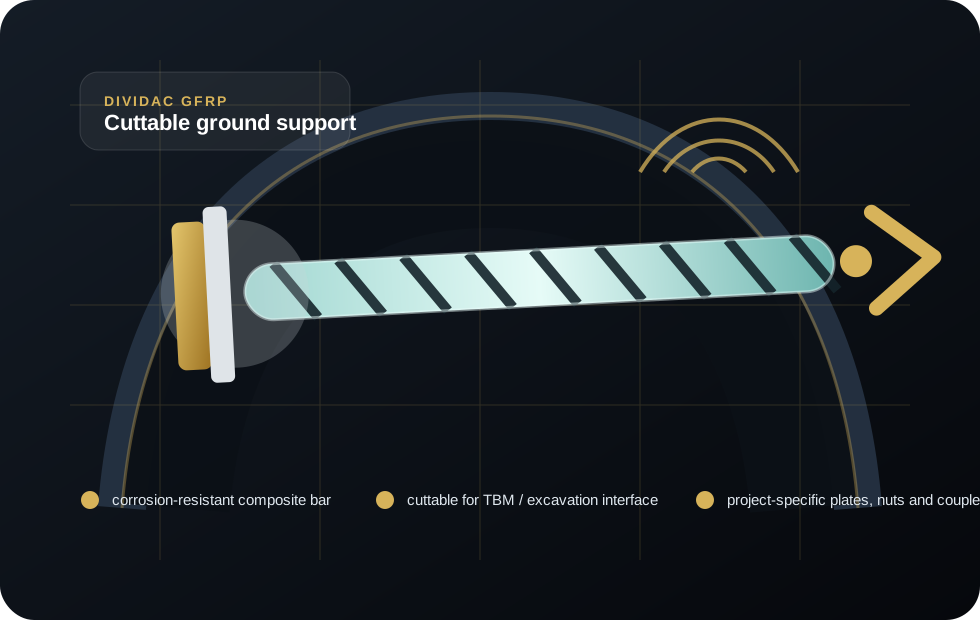
Position GFRP as a construction-risk reduction product, not just a bar replacement.
GFRP is suitable where future mechanical excavation may intersect temporary reinforcement. This helps avoid steel obstruction at diaphragm walls, tunnel eyes, cross passages, shafts and break-through zones.
Using cuttable ground support can reduce cutting, obstruction-removal and cutter-head risk, supporting smoother excavation sequencing for main contractors.
The reduced bar weight helps crews handle longer support elements more easily, especially in constrained tunnel, shaft or ELS working areas.
Composite reinforcement provides a non-steel alternative for environments where corrosion risk, temporary support duration or exposure conditions need to be considered.
Depending on load and application, systems can be discussed with composite or steel nuts and plates, grout tubes, centralizers, couplers and low-profile head details.
DIVIDAC can support main contractors with product descriptions, indicative capacities, batch test requirements, material certificates and tender-stage technical clarification.
Final selection should always be checked against project drawings, design assumptions, test data and batch certification.
| Topic | Typical project discussion |
|---|---|
| Applications | Temporary or permanent soil nails, rock bolts, tunnel face bolts, TBM interfaces, ELS works, tunnel eyes and break-through zones. |
| Bar concept | Glass fiber reinforced polymer composite bar produced from high-strength glass fiber and resin matrix, with threaded/deformed profile options for bond and installation. |
| Typical size range | Common GFRP system ranges include nominal diameters such as 20, 25, 32 and 38 mm, with project-specific larger bars available subject to technical review. |
| Example GFRP 40 discussion | Example project data reviewed included 40 mm outer diameter, modulus of elasticity ≥ 50 GPa, guaranteed tensile load ≥ 850 kN, tensile stress area 950 mm², transverse shear stress ≥ 124 MPa and ultimate tensile strain ≥ 1.2%. |
| Batch testing | Typical batch documentation may cover cross-sectional properties, modulus of elasticity, tensile strength, ultimate strain, shear strength, glass fiber content, dye wicking and Barcol hardness. |
| Accessories | Composite or steel nuts and plates, grout tube, centralizers, drill bits, steel couplers and galvanized steel accessories where required by the project design. |
Main contractor use cases
For tender and construction teams, the value is strongest where temporary support must later be excavated, trimmed or intercepted by mechanical equipment.
DIVIDAC can help convert this into a practical product proposal: application area, bar size, accessory type, loading requirement, test certificate requirement, delivery schedule and method statement interface.
Send the project assumptions early so the correct size, accessory and document package can be reviewed.
Required working load, temporary or permanent use, excavation interface, design life and whether future cutting is expected.
Diameter, length, thread requirement, plate size, nut type, coupler requirement, grout tube and centralizer requirements.
Trial quantity, project quantity, delivery date, packaging, delivery term and required technical submittal format.
Send the drawings, specification, required bar length, load assumptions and installation area. DIVIDAC can prepare a focused technical sales response for contractor review.